Is SolidCraft a Fusion 360 clone? What "clean-room" means, and the ArtCraft connection
Short answer: SolidCraft is an independent open-source parametric CAD program (MIT OR Apache-2.0) whose workflow feels familiar to Fusion 360 users. The project says it contains no Autodesk code, icons or artwork. It was built from public documentation, general CAD conventions and user feedback under written "clean-room" rules. It cannot open Fusion's .f3d files, and it is not affiliated with Autodesk. Whether "clone" is fair depends on what you mean: the look and the workflow, yes, many users say so; the code and the file format, no. Nobody outside the project has independently verified the clean-room claim, and this article is not legal advice.
Why people call it a clone
The comparison comes from users, not from the project's own description:
- At its Show HN launch (13 October 2026), commenters wrote that "it looks a lot like Fusion" and guessed whether it was modelled on Inventor or Solid Edge.
- On a 3D-printing forum a user who tried it wrote that it "seems to be a Fusion clone and reacts the same".
- Search data for this site shows the same framing: people search "fusion 360 clone", "autodesk fusion clone" and "solidcraft artcraft".
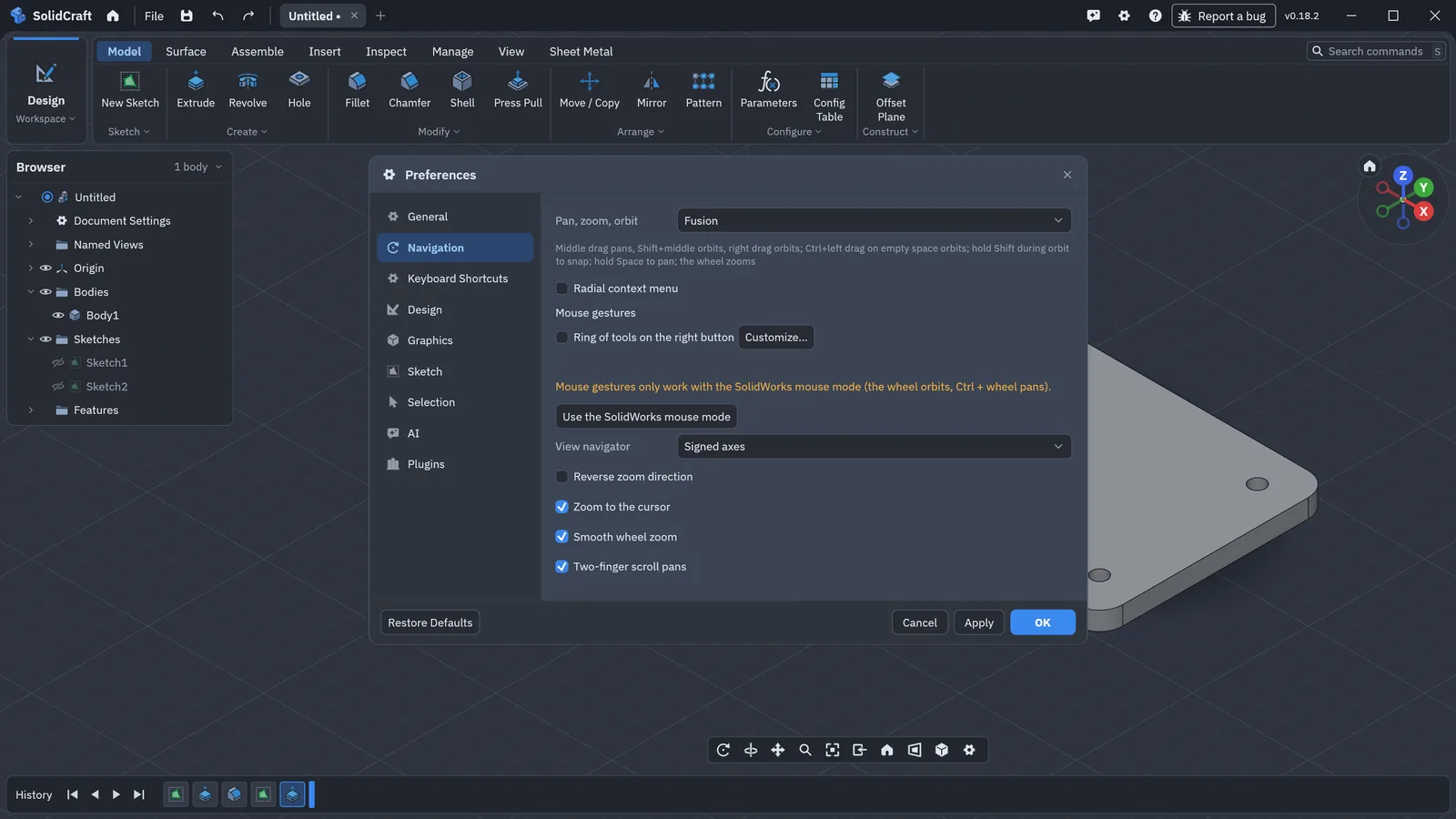
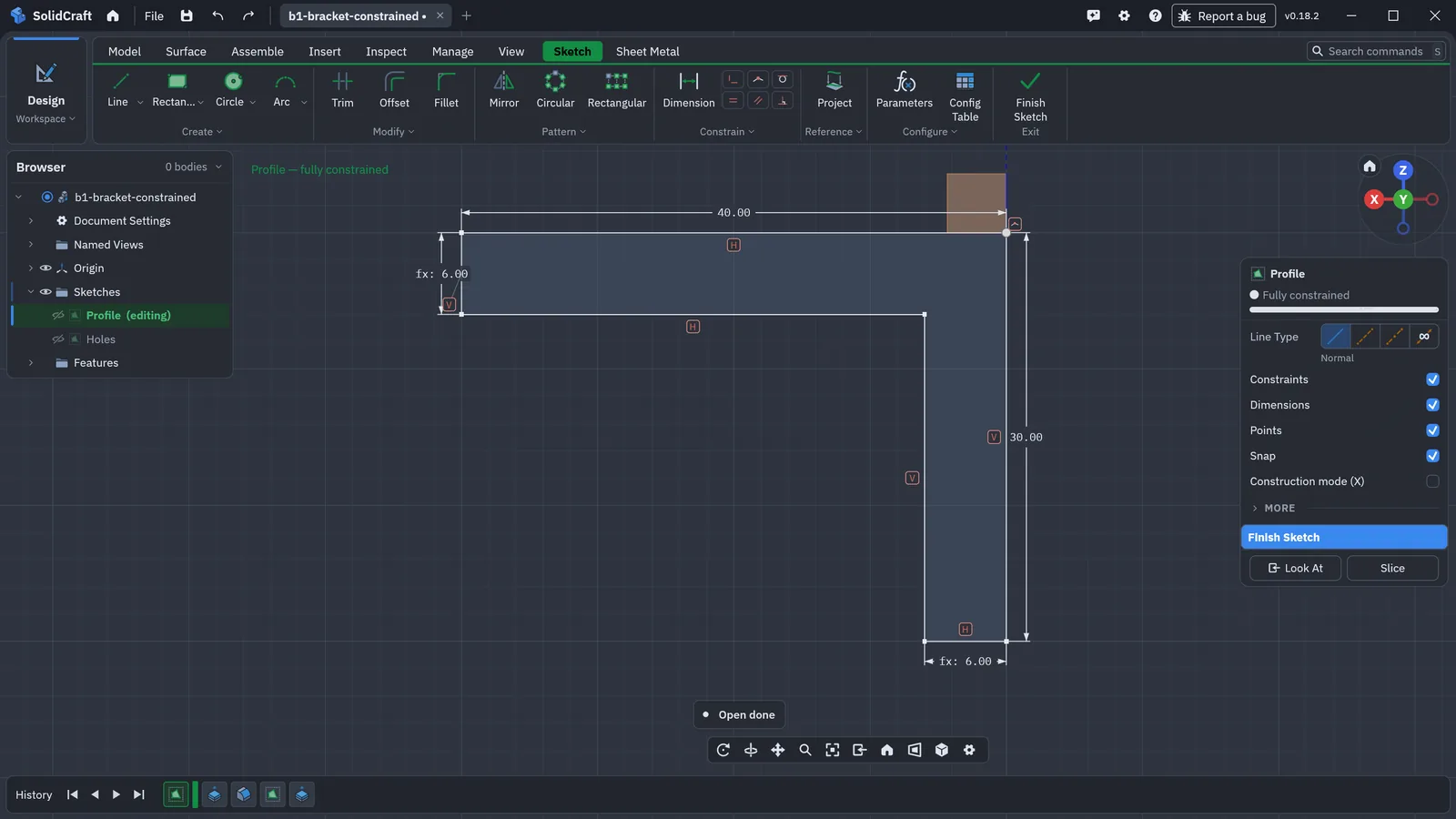
Some of the familiarity is deliberate. SolidCraft's NOTICE file mentions "mouse navigation presets in Preferences › Navigation" named after other CAD programs. Many concepts are general parametric-CAD conventions that Fusion shares with other tools: sketches with constraints, a feature timeline, named parameters, assemblies with joints.
What the project's own rules say
SolidCraft's README says it was "Developed under the clean-room contribution rules". Those rules, in the repository's AGENTS.md, are unusually explicit:
- Independent: "Behaviour is designed from public documentation, general CAD conventions and user feedback… Never copy another product's code, icons, artwork, help text, tooltips, templates or materials. File formats come from public specifications."
- No commercial CAD in the loop: contributors and AI agents "must not drive, script, automate or extract data from commercial CAD products (Fusion, SolidWorks, Onshape, …)", so no test data, measurements, command lists or files made with them.
- No copyleft CAD code either: OpenCASCADE, FreeCAD, SolveSpace, CadQuery and others must not be read, copied or linked. FreeCAD is only run as a separate program to compute reference values for tests.
- Assets: "no iconography, images, fonts or artwork from commercial CAD products — ever", and screenshots of commercial CAD software are never committed.
The NOTICE adds that SolidCraft is "not affiliated with, sponsored by or endorsed by Autodesk, Dassault Systèmes, PTC, Siemens, Blender or any other CAD vendor". Product names appear "only to describe compatibility".
What "clean-room" means, and its limits
Classic clean-room design separates two teams. One studies the original and writes a specification; the other, which has never seen the original, implements from that specification. The 1980s IBM-compatible BIOS is the textbook example. The separation is mainly evidence that nothing was copied.
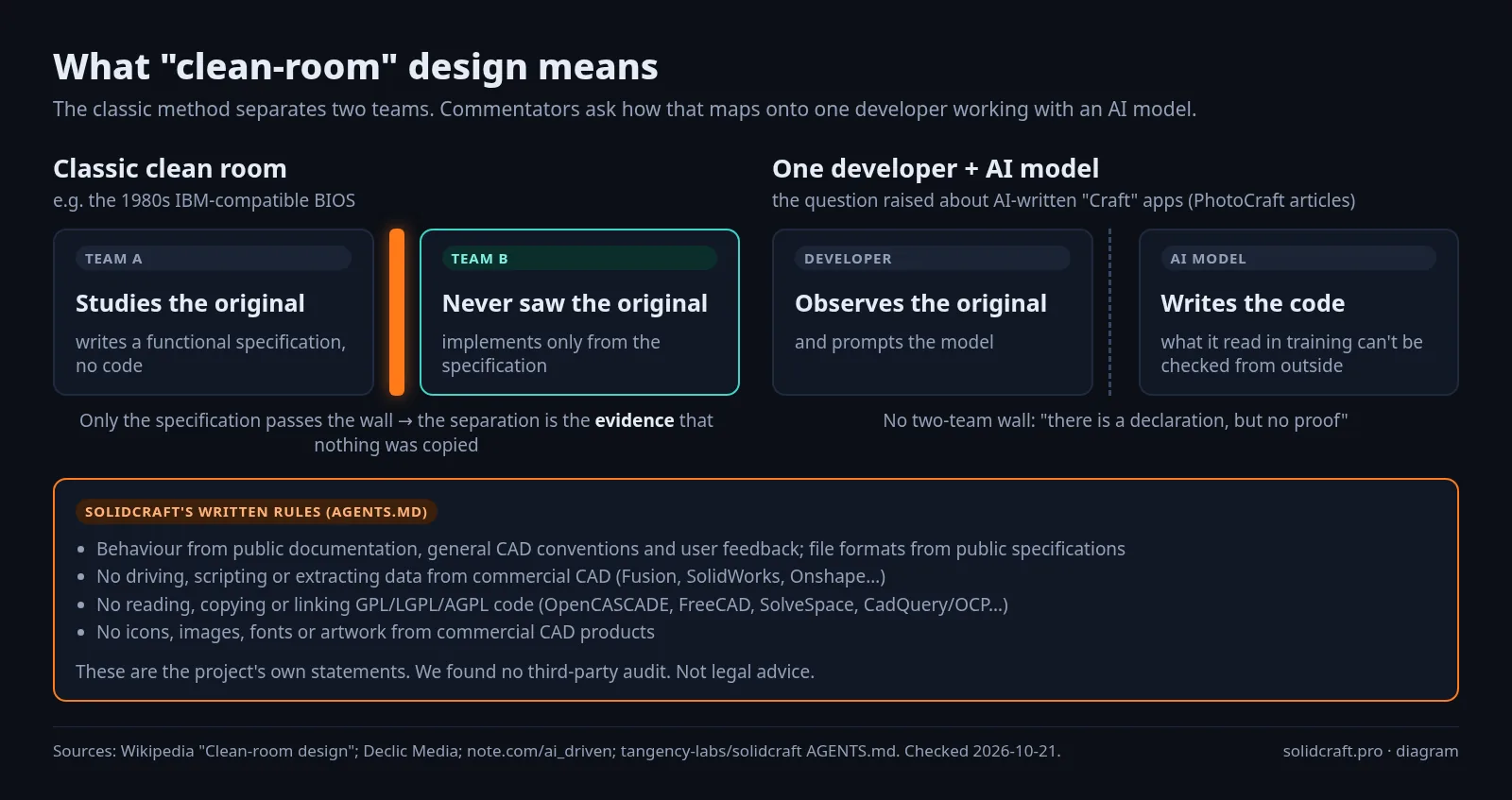
Commentators have raised a specific question about AI-written "Craft" apps. Writing about ArtCraft's PhotoCraft (a clean-room Photoshop-style editor), Declic Media notes that when one developer observes the original product and then prompts a model to write the code, there is no two-team wall. It also notes that "what the model read during training" can't be checked from outside. Japanese reviewer note.com/ai_driven summed up the situation as "there is a declaration, but no proof". Those articles are about PhotoCraft, not SolidCraft, but the same questions apply to any AI-assisted clean-room claim. We found no third-party audit of SolidCraft's code.
Practical takeaway: for personal and hobby use, the licence (MIT OR Apache-2.0) is clear and permits commercial use of the software and of the parts you design. If your company is standardising on a CAD tool, ask your own legal team, as you would for any young open-source project.
How SolidCraft relates to ArtCraft and the "Craft" apps
What the sources show:
- SolidCraft is published by the tangency-labs organisation on GitHub; solidcraft.io says "© Tangency Labs". It was first published by Brennen Herbruck (GitHub: bherbruck) under the name SolveCraft, and the repository later moved to tangency-labs.
- Its NOTICE says some code is "adapted from sibling projects in the storytold family (CADCraft, GridCraft)", and that its release packaging is adapted from PhotoCraft (github.com/storytold/photocraft). Its agent rules say projects published by storytold "can serve as references for implementation conventions".
- CADCraft (an AutoCAD-style 2D/3D CAD app) and PhotoCraft describe themselves as part of the "Crafting Apps … from the ArtCraft team". ArtCraft itself is an AI image and video studio.
- SolidCraft's own README and website do not list it as an ArtCraft app.
So SolidCraft shares code, conventions and the "Craft" naming with the storytold/ArtCraft family, but it is presented as its own project under Tangency Labs. We have not found an official statement describing the organisational relationship, and we won't guess.
What carries over from Fusion 360, and what doesn't
| Status in SolidCraft 0.18.2 | |
|---|---|
| Fusion .f3d files | No importer. Export STEP from Fusion instead (how) |
| Fusion feature history | Lost through STEP. The part arrives as a base feature you can build on |
| Mouse navigation feel | Navigation presets in Preferences › Navigation |
| Concepts (sketch, constraints, timeline, parameters, joints) | Yes, as general CAD conventions |
| CAM, 2D drawings, simulation | Not yet. Deferred on the official roadmap (review) |
| Autodesk account or cloud | Not needed. Runs locally or in the browser |
For a full side-by-side comparison, see SolidCraft vs Fusion 360.
Quick answers
Is SolidCraft made by Autodesk? No. It is independent and not affiliated with Autodesk.
Is it legal to use SolidCraft? It is published under MIT OR Apache-2.0, which allow personal and commercial use. Questions about clean-room claims and trade dress are for lawyers, not for this guide.
Is SolidCraft made by the ArtCraft team? It shares code and conventions with the storytold/ArtCraft "Craft" apps, but it is published by Tangency Labs and doesn't call itself an ArtCraft app (as of 21 October 2026).
Can it open my Fusion projects? Not .f3d. Use STEP.
Sources (checked 2026-10-21)
- SolidCraft README, NOTICE and AGENTS.md — https://github.com/tangency-labs/solidcraft
- solidcraft.io footer ("© Tangency Labs") — https://solidcraft.io/
- CADCraft README ("By the ArtCraft team") — https://github.com/storytold/cadcraft
- PhotoCraft README ("Crafting Apps … from the ArtCraft team") — https://github.com/storytold/photocraft
- Show HN thread — https://news.ycombinator.com/item?id=50064840
- 3dprintingspace forum thread — https://3dprintingspace.com/t/new-cad-for-modelling-prints/10555
- Clean-room design — https://en.wikipedia.org/wiki/Clean-room_design
- Declic Media, "Photoshop cloned with Claude: is it legal?" — https://www.declic.media/en/news/artcraft-adobe-clean-room/
- note.com/ai_driven, review of ArtCraft from primary sources — https://note.com/ai_driven/n/nc9f704e8b2df
More articles: SolidCraft blog · Not affiliated with SolidCraft or Tangency Labs (about this site).